 ESPEC North America, Inc. (Corporate office)
4141 Central Parkway
Hudsonville, MI 49426 USA ESPEC North America, Inc. (Colorado/Qualmark office)
12600 E. Smith Road
Aurora, CO 80011 USA
303-254-8800

Following are links to the most popular thermal shock testing standards in use today.
EIA’s JEDEC Solid State Products Engineering Council has many published specifications for environmental testing. The JESD22 group of specifications include temperature/humidity, thermal shock, and HAST. You must register, but the standards are free!
The electronics industry has used this Military Standard 883 as theirs. It is what the JEDEC spec listed above is based on. This page offers the entire text of the standard in Adobe Acrobat format, but you don’t need the whole thing. (Note: Current version is “883J Method 1010.8”. Previous versions 883C, 883D, 883E, 883F, 883G, 883H are the same basic standard, which was numbered 1010.6 and 1010.7.)
Another thermal shock method is part of Military Standard 202. Once again, you don’t need the whole specification, just a few pages.
Our Technology Reports cover thermal shock testing as part of a general review of testing methods, as well as specific articles. These are in the Adobe Acrobat format.
Issue #3 (pdf link)
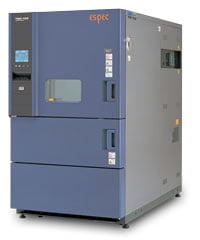
Five types of thermal shock chambers, including air-to-air and liquid-to-liquid:
ESPEC North America, Inc. (Corporate office)